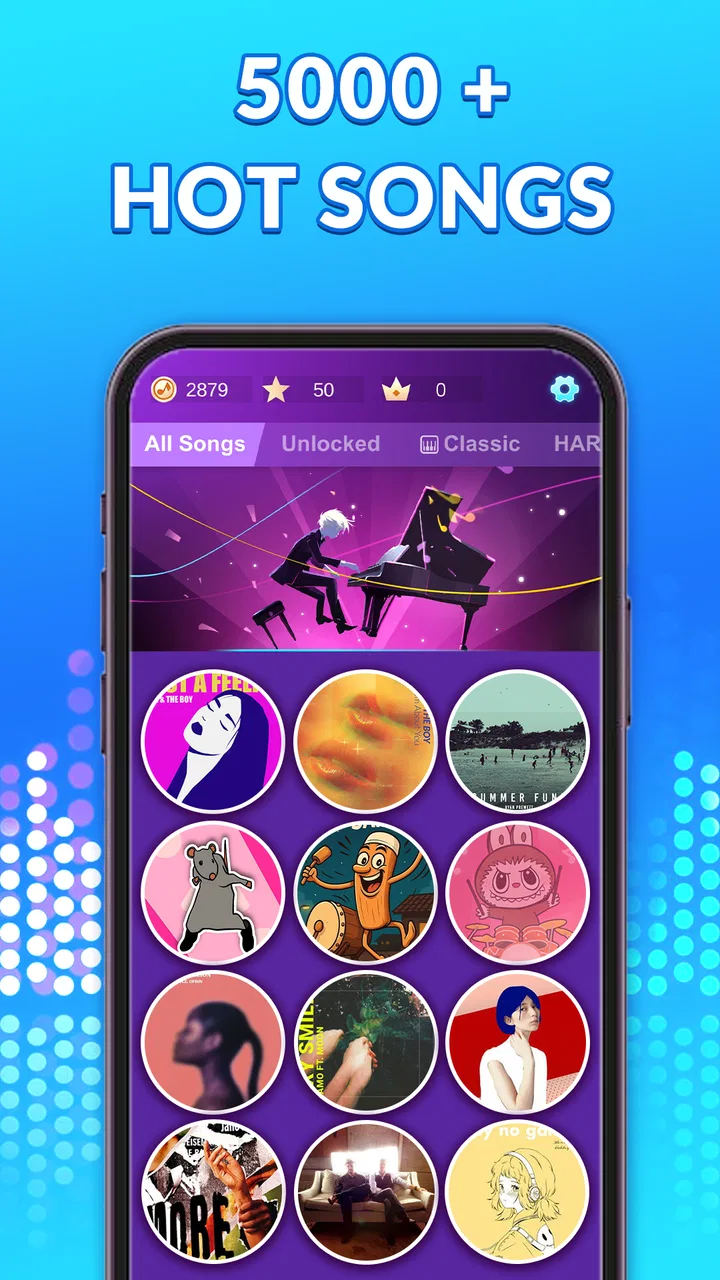
Piano Hotwave
- 4.2
- Rating
- 1.00M
- Installs
- Free
- Price

 Analysis by App-foxy
I approached Piano Hotwave as a quick music game rather than a piano-learning tool, and that distinction matters from the first session. Its appeal is immediate: listen for the rhythm, react quickly, and try to keep the run alive. The game comes from Clingycat Games, sits in the music category, and is free to start, with optional purchases listed from $7.99 to $12.99 per item. That makes the important question less about whether it costs anything to download and more about how comfortable you are with a game that may place spending alongside its rhythm challenge.
My overall impression is positive but measured. The compact concept is easy to understand, the Everyone age rating makes it approachable for a broad audience, and the game has clearly found an audience, with more than a million installs and a 4.2 average from roughly 1,500 ratings. At the same time, a rhythm game lives or dies by timing, clarity, and the feeling that success comes from better play rather than pressure to buy. Piano Hotwave is most interesting when it stays focused on that musical reflex loop.
How the rhythm loop feels in everyday play
The best way to understand this game is to imagine a spare five-minute window: you are waiting for a friend, taking a break between tasks, or sitting on the sofa with enough attention for one more attempt but not enough time for a long campaign. A music game built around fast reactions fits that moment naturally. You can pick it up without first learning a complicated control scheme, then stop when your attention starts to fade.
You May Also Like

 Blood Strike: 2.5 Anniversary
Blood Strike’s Loadouts Turn Every Drop Into a Tactical Gamble
A close look at Blood Strike’s custom loadouts: how fast access to signature weapons reshapes its battle royale rhythm, rewards preparation, and narrows the gap between fights.

 Pandora - Music & Podcasts
Pandora’s Music Is Easy to Start, but Harder to Recover
Pandora’s strength is its low-effort path from a seed to a station. Its weak spot is how much confidence it asks you to place in connection, setup, and quiet recovery.

 8 Ball Pool
 Is Built on Rivalries, Rematches, and Routine
A close look at the rivalries, rematches, shared routines, and unanswered safety questions that turn a quick pool match into a persistent mobile community.

 Samsung Music
’s Quiet Strength Is Playing What You Already Own
Its reach comes less from spectacle than from dependable access to a personal library. That simplicity is both the app’s strongest retention engine and its ceiling.

 AccuWeather: Weather Radar
AccuWeather Review: A Quick, Clear Forecast for Everyday Decisions
For everyday plans, the best forecast is the one you can understand quickly. AccuWeather makes rain timing, radar, and local conditions easy to act on, with a few trade-offs.

 Hill Climb Racing
Why Hill Climb Racing Still Turns Crashes Into One More Run
A tiny car, a bumpy hill and one more upgrade: Hill Climb Racing keeps resurfacing because its simple chaos makes every near-miss feel personal.
More From Our News Desk



That convenience is also the source of its limitation. A short-session rhythm game depends heavily on whether the central action remains satisfying after the novelty wears off. The first attempts are about learning the visual rhythm and getting used to the speed. Later attempts need to offer a reason to improve: a cleaner run, a harder pattern, or the simple satisfaction of finally passing a section that previously caught me out. If that personal improvement does not interest you, the experience can feel repetitive sooner than a larger music game.
I would not recommend treating it as a substitute for a digital piano, a structured lesson app, or a serious ear-training course. The store summary presents an energetic beat-focused experience, and that is the right expectation. You are playing along with a game system, not building proper technique, reading sheet music, or learning how to perform a song on a physical instrument. That makes it a good casual choice for rhythm fans and a poor choice for someone searching for measurable musical instruction.
The touch controls are especially important here. On a rhythm title, small interruptions can change a fair challenge into an irritating one. I found it best to play with the device held steadily, use a consistent finger position, and avoid starting a run when I was likely to be interrupted. This sounds obvious, but it is a useful habit: changing grip halfway through a fast sequence can make the game feel harder than it really is.
A second practical tip is to separate learning attempts from score attempts. During the first few rounds, I pay attention to the visual cues and the spacing between actions instead of chasing a personal best. Once the sequence feels familiar, I concentrate on accuracy and continuity. That two-stage approach reduces the temptation to restart immediately after one mistake and helps reveal whether a difficult moment is genuinely demanding or simply unfamiliar.
The current version is 1.4.0, and it runs on Android devices using version 6.0 or later. That broad compatibility is useful for people who do not own a recent phone, although rhythm games still benefit from a responsive screen and reliable audio. A device meeting the minimum system requirement may launch the game, but the quality of the experience will also depend on how comfortably it handles rapid touch input and sound without distractions.
Who will enjoy the format most
I see the strongest fit for players who like compact arcade sessions, music-themed challenges, and gradual improvement without committing to a long story. It can also work as a low-pressure introduction to rhythm games for someone who has not played many before. The basic idea is easy to explain to a friend: follow the beat, react accurately, and try again when the pattern defeats you.
People who prefer exploration, character development, or a large collection of strategic systems should look elsewhere. Piano Hotwave is not the right pick if you want a deep role-playing progression, a simulation of playing real piano, or a game where every session unfolds differently through a complex world. Its identity comes from repeating a focused action until your timing improves.
It is also worth considering your playing environment. Music games are naturally less convenient in places where sound must stay off, and a crowded commute can make precise tapping uncomfortable. If you mostly play with notifications appearing, one hand occupied, or the phone resting at an awkward angle, frustration may come from the circumstances rather than the design. I get better results when I give it a quiet moment and treat a run as a small focused activity.
Progress, pressure, and the cost of continuing
The free entry point is a genuine advantage. You can decide whether the rhythm loop suits you before paying anything, which is more sensible than committing to a premium purchase based only on a short description. The listed optional items cost between $7.99 and $12.99 each, so spending is not trivial for a casual game. I would approach those purchases as optional extras rather than part of the basic decision to try the game.
That price range also changes how I judge progress. In a rhythm game, difficulty should ideally encourage practice: you replay a section, understand the timing, and become more consistent. If a player starts feeling that progress is being slowed mainly to make a purchase attractive, trust drops quickly. I would therefore pay attention to my own reaction during repeated attempts. Am I learning the pattern, or am I being nudged toward spending because the game has made ordinary improvement feel inconvenient?
There is a useful discipline for free-to-play music games: do not buy during a frustrating streak. If I miss several runs in a row, I take a break and return later. That prevents a temporary loss of concentration from turning into an unnecessary purchase. It also gives me a clearer view of whether the game is enjoyable on its own terms. The fairest test is whether I still want to play when I am not paying to change the experience.
Families should have a similar conversation before handing the game to a child. The Everyone rating describes the intended age suitability, but it does not remove the need for adults to supervise spending on a device. Since individual purchases are available, I would check the device’s purchase protections and make sure the player understands that downloading a free game does not mean every optional item is free.
I am careful not to read more into the purchase structure than the listed facts support. The available purchase range tells me that optional spending exists and can be substantial relative to a quick casual game. It does not, by itself, establish whether purchases affect songs, retries, cosmetics, progression speed, or competitive results. That distinction is important, because fairness depends on what those items actually do in play.
Can the challenge feel competitive without feeling pay-driven?
Rhythm games are naturally competitive even when there is no formal tournament structure. Players compare scores, chase cleaner performances, and judge themselves against previous attempts. That creates a strong form of personal competition: the opponent is often yesterday’s version of you. Piano Hotwave benefits from that simplicity because a better run feels meaningful when the improvement comes from timing and concentration.
The harder question is whether optional spending can influence that feeling. If purchases only change presentation, the core contest remains easier to trust. If they provide retries, shortcuts, access, or advantages that affect results, the game would feel less satisfying to players who want a pure test of ability. I cannot responsibly assign one of those models without seeing the exact role of each purchase in the active game, so I would make any buying decision only after checking the item description displayed at the point of purchase.
That uncertainty does not make the game unusable, but it does affect my recommendation. For solo players who simply enjoy tapping along to music, the issue may matter less. For friends comparing scores or for anyone who values strict skill-based competition, it matters a great deal. I would keep the competitive standard personal unless the game clearly shows that everyone is working with the same conditions.
A practical way to keep the experience fair is to set a no-purchase period. Play enough sessions to decide whether the basic loop holds your attention, and compare your results only with runs made under the same conditions. This avoids treating a paid option as a necessary part of the game before you know whether it changes anything relevant to performance.
I also recommend judging difficulty over several sessions rather than one bad evening. Fatigue, background noise, touch-screen sensitivity, and unfamiliar patterns can all distort your impression. A game that feels unfair after a single rushed attempt may feel manageable once you learn its visual language. Conversely, a pattern that seems exciting at first may become tiresome if every later session repeats the same pressure without offering a satisfying sense of progress.
What I would check before spending
The purchase screen deserves more attention than the download screen. I would read the exact description of each item, note whether it is a one-time purchase, and check what changes immediately after buying it. I would also look for any wording that separates permanent content from temporary benefits. Those details are more useful than assuming that a higher-priced item automatically represents better value.
I would use the same caution with the game’s progression. Before buying anything, I would ask myself three simple questions: can I continue enjoying the available play without paying, does the purchase solve a problem I genuinely have, and would I still want the item after taking a day away from the game? If the answer to the first question is no, the purchase is not fixing the right problem; it is deciding whether the game is suitable for me.
Another overlooked issue is attention. A rhythm game can be enjoyable while also encouraging repeated attempts, because every failure feels close to success. That design can make a short break expand into a much longer session. I find it helpful to decide in advance whether I am playing for a few rounds or practicing a specific pattern. That boundary keeps the game entertaining instead of turning it into an automatic loop.
For parents, I would add a fourth check: make sure the child knows that improved timing is the intended path to progress. If the player believes that a purchase is the normal answer to every failed run, the game teaches the wrong lesson about challenge. The Everyone rating makes it accessible, but accessibility is not the same as financial simplicity.
Where the game sits beside other music options
Compared with a piano-learning application, this is much more immediate and much less educational. A lesson app usually asks for patience, practice routines, and attention to musical fundamentals. Piano Hotwave asks for quick reactions and repeat attempts. I would choose the game for entertainment and the lesson app for building a skill; neither replaces the other.
Compared with a premium rhythm game that charges once, the free download is easier to sample but may require more caution around optional spending. A paid game can feel cleaner when its full challenge is available from the start, while a free game lets you test compatibility with your device and your taste before committing. The better value depends on how long you play and whether the optional items feel necessary.
Compared with a music streaming service, the purpose is completely different. Streaming gives you passive listening and broad choice; this game turns music into an active timing task. I would open it when I want something to do with the beat, not when I want background music during work or travel. That difference sounds basic, but it prevents disappointment caused by expecting a music library instead of an arcade challenge.
Compared with a traditional piano game that emphasizes song collection or performance fantasy, Piano Hotwave’s strongest quality is likely its directness. There is less reason to overthink the premise. If you enjoy the sensation of responding to a beat and improving through repetition, that focus can be refreshing. If you need extensive customization, long-term collecting, or a strong social layer, another option may hold your attention better.
My trust verdict after weighing the trade-offs
Clingycat Games has positioned this as a free music game with a very accessible starting point, and the reception so far is encouraging: the title has passed a million installs, carries a 4.2 average, and has gathered about 1,500 ratings. Those figures suggest that it is not an obscure experiment with no audience, but popularity alone does not answer the fairness question. The real test remains how the optional items interact with the rhythm challenge.
I trust the game most as a casual, skill-centered pastime when I treat purchases as separate from the basic test. Download it, learn the timing, play in short sessions, and decide whether the free experience is already worth your time. If you later consider an item, inspect its exact function rather than assuming it improves the music or makes you better. That approach protects both your budget and your opinion of the game.
The release date of June 26, 2025 and the current version show that this is a relatively recent title with an active version number, but I would not use that alone as a promise about future content or support. What matters to me today is whether the installed version feels responsive, readable, and enjoyable on the device I actually use. A recent release can still be the wrong fit if its rhythm does not match my preferences.
For a friend, my recommendation would be conditional but clear: try it if you want a free, quick music challenge and enjoy improving through repetition. Keep spending disabled until you understand what the optional items do. Skip it if you are looking for piano instruction, a rich story, or a guaranteed one-price experience with no purchase decisions. Piano Hotwave works best when the beat, not the checkout screen, is the reason you return.
FAQs for Piano Hotwave
01What is Piano Hotwave and how does it work?
Piano Hotwave is a music simulation app available on Android and iOS that allows users to play piano using their mobile devices. The app features a variety of songs ranging from classical to pop. Users can follow along with a guided mode or play freely, making it suitable for both beginners and experienced musicians.
02Is Piano Hotwave suitable for beginners?
Yes, Piano Hotwave is designed to cater to all skill levels. Beginners will find the guided mode particularly useful, as it provides step-by-step instructions and visual cues to help them learn songs easily. The app also includes lessons and practice sessions to build foundational skills.
03Does Piano Hotwave require an internet connection?
Piano Hotwave can be used offline for playing and practicing with pre-downloaded songs. However, an internet connection is needed to access new songs, updates, and online features such as leaderboards or community interactions. It's a flexible app that allows for both online and offline use.
04Are there in-app purchases in Piano Hotwave?
Yes, Piano Hotwave offers in-app purchases. While the app provides a selection of free songs and features, users can purchase additional song packs, premium features, and an ad-free experience. These purchases are optional but enhance the app's functionality and content variety.
05What devices are compatible with Piano Hotwave?
Piano Hotwave is compatible with a wide range of devices running Android and iOS. For the best experience, it's recommended to use a device with a recent operating system version and sufficient screen size, allowing for comfortable playability and responsiveness during fast-paced songs.
Pros
- Engaging and intuitive user interface.
- Wide variety of songs to choose from.
- Realistic piano sound quality.
- Smooth performance with minimal lags.
- Supports offline play for convenience.
Cons
- Limited free song choices available.
- In-app ads can be intrusive.
- Premium features can be pricey.
- Occasional bugs in playback.
- Requires significant storage space.

Piano Hotwave
Gallery